
Most published SaaS GEO results are a screenshot of one AI answer with the brand circled. Zumi's measurements show why that proves little. In a run of 8,740 answers, a single run's result for a brand disagreed with that brand's usual result on the same question in 21.2% of observations.
A SaaS team buying GEO work, or reporting its own, needs a test for what counts as a result. This guide starts with that test, then covers the playbook it is meant to measure.
Key takeaways
- A credible SaaS GEO result has four parts: a baseline on a fixed question set, repeat runs over a stated window, figures kept per engine and per competitor set, and a source for every number.
- One check is a weak basis for a claim. A single run disagreed with a brand's usual result 21.2% of the time, and only 6.3% of brand and question pairings showed the brand in every run.
- In a Zumi run of 4,308 cited answers about one software category, third-party pages took 91.6% of citations and the tracked vendor's own pages 1.6%.
- Best-of lists, comparison pages, and alternatives pages together took 39.0% of citations in that software category.
- The playbook itself is well known: define the category, cover its sub-topics, earn third-party coverage, and keep it current.
What counts as evidence in a SaaS GEO result?
Each of the four parts answers a way a result can mislead.
A baseline on a fixed question set. The result names the category questions tracked, the engines, and the starting figure. Without a fixed set, a later run can look better simply because it asked easier questions.
Repeat runs over a stated window. Across the same 8,740 answers, only 6.3% of brand and question pairings showed the brand in every run. A before-and-after built on one run each side can be noise in both directions.
Figures kept per engine and per competitor set. Engines differ in stability: Google AI Overviews repeated a brand mention 62.3% of the time, ChatGPT 54.7%.
Share of voice also changes whenever a competitor is added to or dropped from the tracked list, even when the brand's own presence does not move.
A source for every number, and a method that says what changed. The result states what was done: pages published, coverage earned, or positioning rewritten. It links every figure to the run behind it.
A result that passes all four is a tracked series: mention rate or share of voice moving over a defined window, against a stated method. A result that fails the second part is a moment. AI Search Intelligence metrics that matter explains each signal in more depth.
Where do SaaS category answers get their sources?
Zumi ran 33 buyer questions about AI search measurement software on eight engines between July 19 and August 7, 2026. Of 5,120 answers, 4,308 cited sources, 50,336 times in all.
| Who owns the cited page | Share of citations |
|---|---|
| Third parties | 91.6% |
| Software vendors in the category (9 domains) | 6.8% |
| The tracked vendor | 1.6% |
Best-of lists took 35.2% of citations, blog articles 26.9%, and product pages 12.1%. Lists, comparison pages, and alternatives pages together took 39.0%. The questions asked which tools are best, which likely raises the share going to lists.
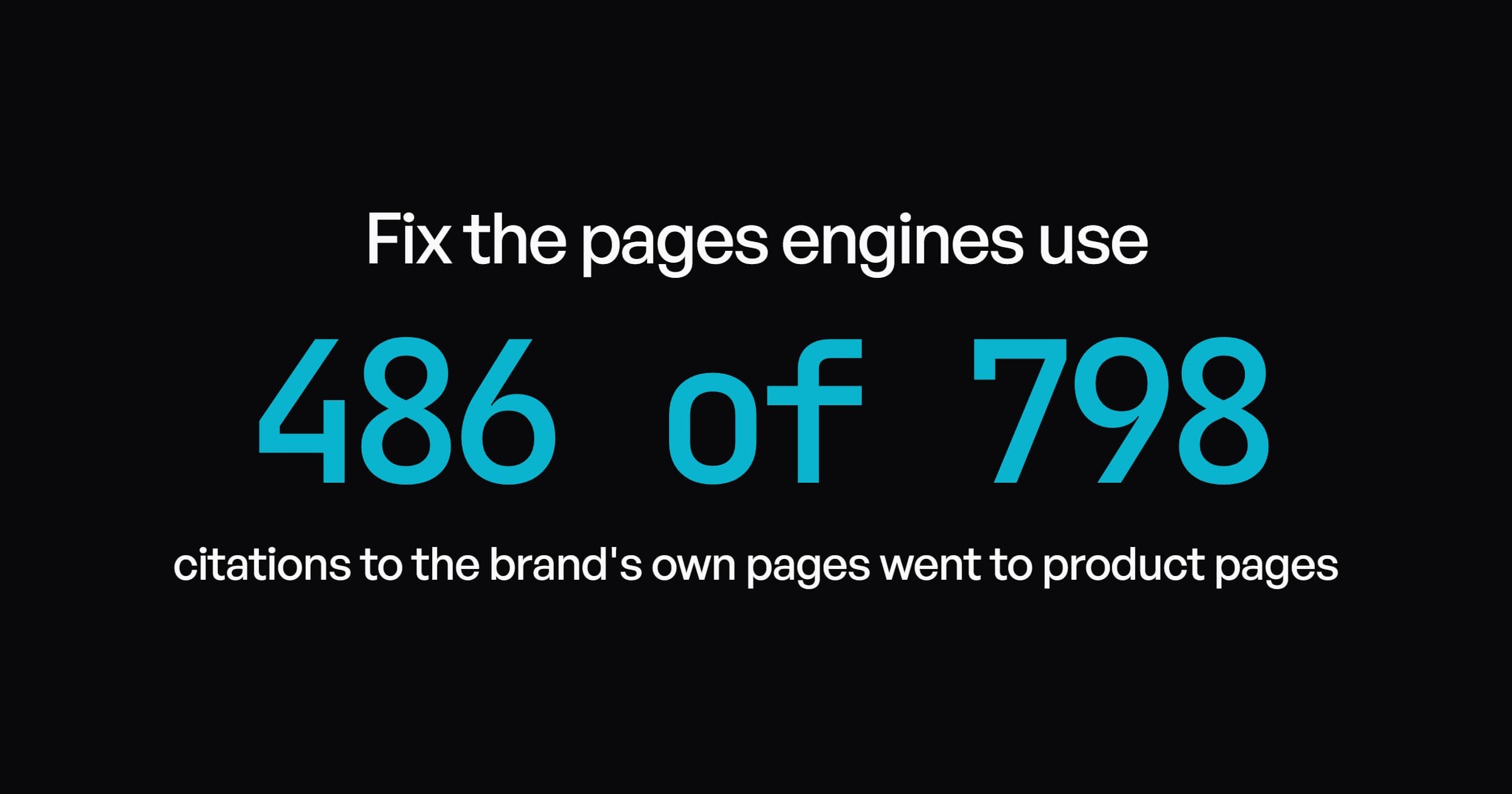
For a SaaS team, the reading is direct. Most of the sources behind a category answer sit on sites the vendor does not own. The vendor's own pages matter most where they are already cited: in this run, 486 of the tracked vendor's 798 citations went to its product pages and 176 to its homepage.
The run covers one category, one 20-day window, and eight engines, with Claude absent. Answers to one question are repetitions, not independent observations.
What does the SaaS GEO playbook involve?
The work a result should measure has four phases. Each is well covered elsewhere, so the summary is short.
| Phase | What it produces |
|---|---|
| Define the category | One clear, current guide to what the category is, the problem it solves, and the buyer it serves |
| Cover the sub-topics | Linked pieces on how it works, use cases, measurement, and the questions buyers ask while shortlisting |
| Earn third-party coverage | Placement on the lists, reviews, and publications engines already cite for the category |
| Keep it current | Scheduled reviews of the guide, the cluster, and the category questions that matter most |
Category questions carry the most weight. A buyer usually asks what kind of tool handles a problem before asking about any one brand, and an AI answer mentions only a few brands where a search page shows a dozen results. The highest-value questions tend to pair a function with a qualifier: the best tool for a company size, an industry, or a use case.
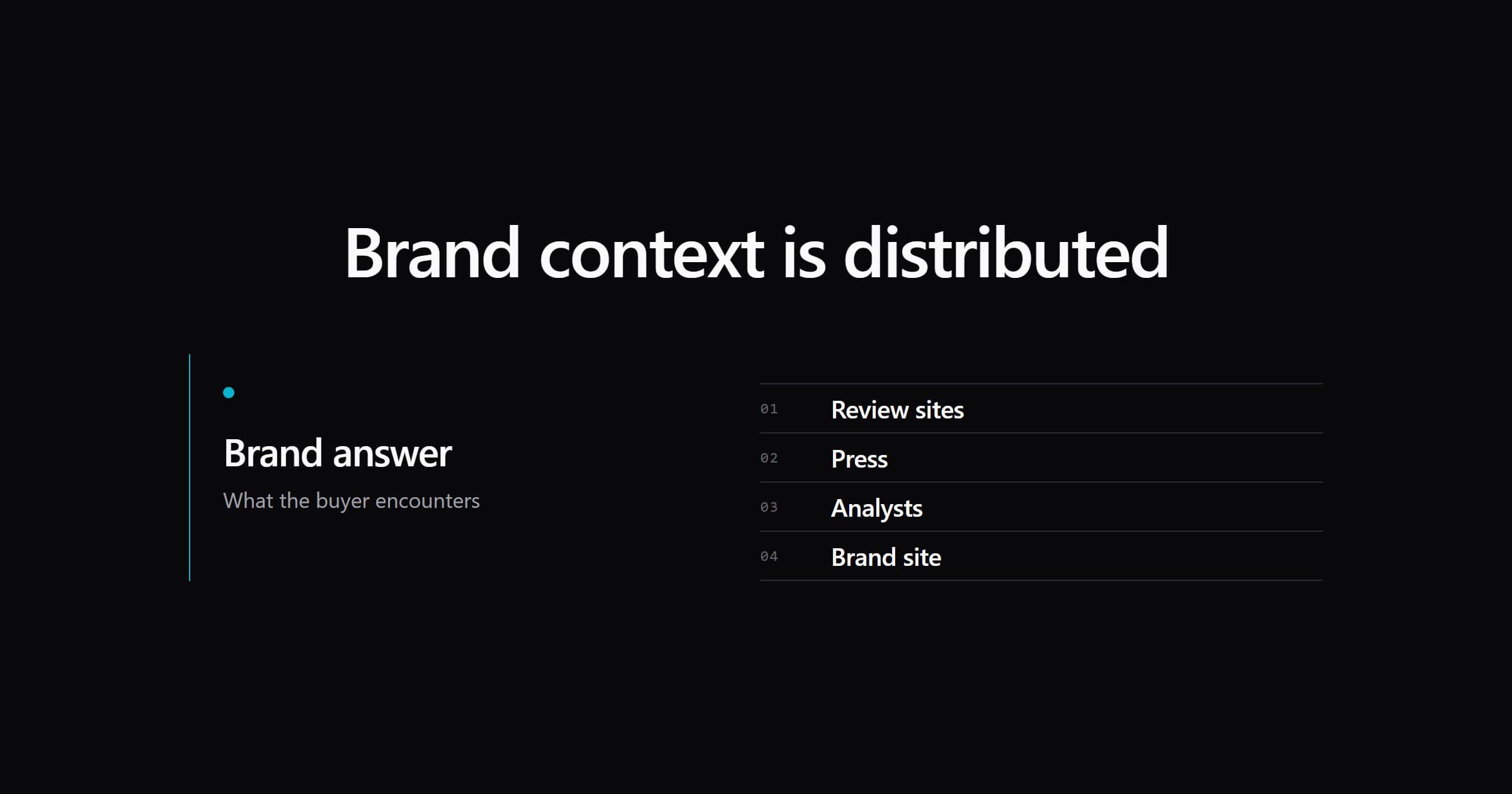
The third phase is where the data above points. With third-party pages taking 91.6% of citations, coverage on the lists and publications engines cite for the category does more than another owned page. How to write content that AI engines cite covers the owned side, and entity optimization for AI covers keeping one description of the brand everywhere.
How should a SaaS team track the result?
The four-part test doubles as a tracking plan. The category questions stay fixed, each runs several times on each engine, the competitor list stays stable, and every report links its figures to the run behind them.
Checking monthly gives lead time on displacement, which usually builds over months as a competitor's coverage grows. The manual baseline method covers a first measurement without a platform.
Zumi is an AI Search Intelligence Platform that tracks mention rate, share of voice, average position, and citation share for a SaaS category's questions, per engine and over time. Book a demo to see the category picture for a real SaaS brand.