
For two decades, branded search was the safest territory in digital marketing. A search for a brand in Google returned the brand's own site at the top, so the brand controlled the answer to questions about itself.
AI answers changed that. When a buyer asks ChatGPT or Perplexity about a brand, the engine writes the answer from the sources it retrieves. The brand's own site is one of those sources, and usually not the main one.
Key takeaways
- A brand's own pages are a small share of what AI engines cite. In Zumi's study of 5,120 AI answers, the tracked brand's pages took 1.6% of 50,336 citations, and third-party pages took 91.6%.
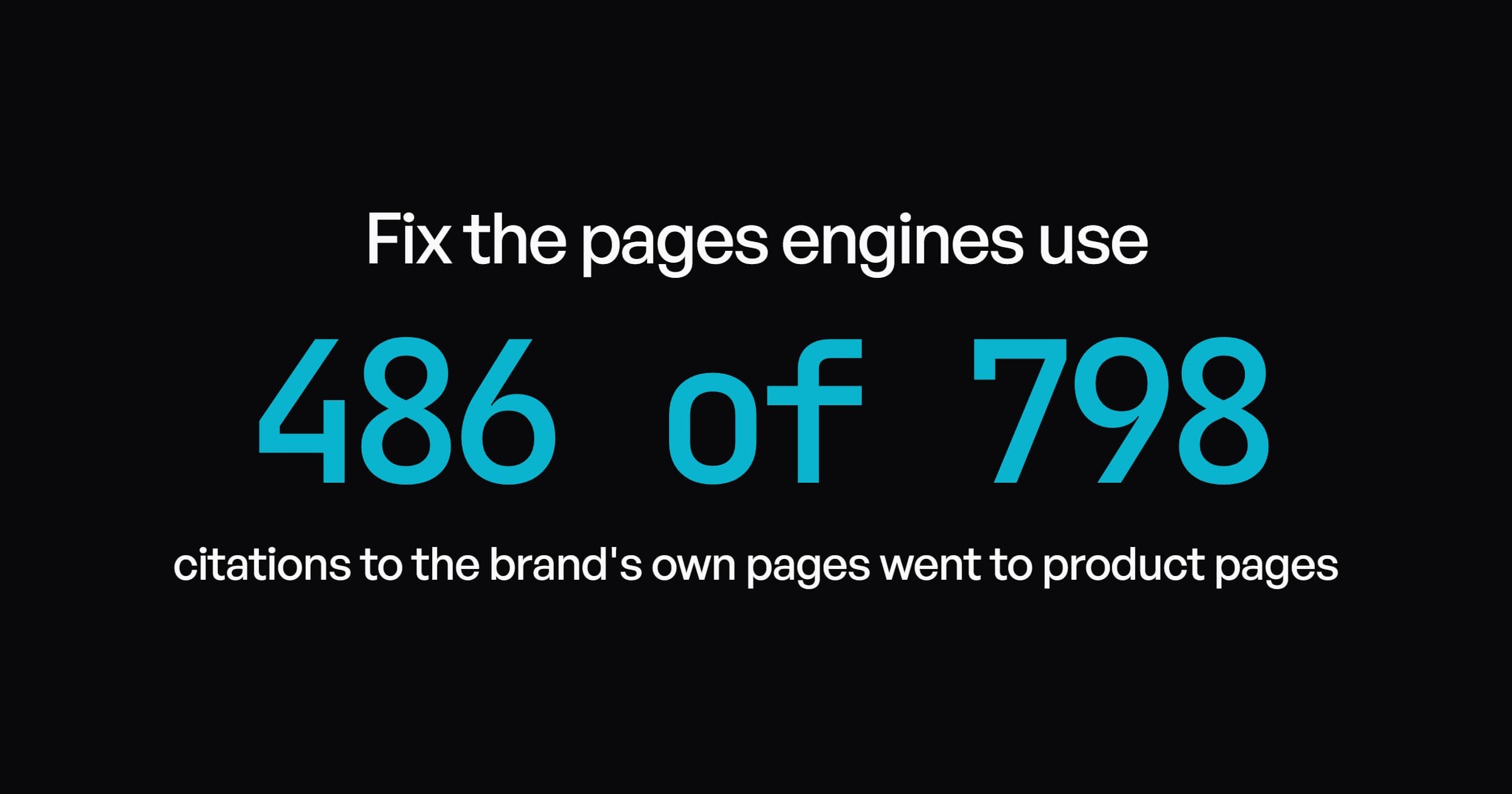
- When the engines did cite the tracked brand, they cited product pages (486 of 798 citations) and the homepage (176). The brand's own facts reach the answer through those pages.
- Branded questions differ in kind. "What does [Brand] do?" asks for facts the brand publishes; "is [Brand] worth it?" asks for a judgment, which an engine has to take from someone else.
- Monitoring works best per question type, recording for each answer whether the brand's own domain was cited and which outside sources carried the description.
What happens when a buyer asks about a brand?
The engine retrieves sources about the brand and writes an answer from them. The brand's homepage and product pages can be among those sources, but they compete with review sites, publishers, forums, and comparison articles.
Zumi measured how that competition plays out in its own study of what AI engines cite. Across 5,120 answers to 33 buyer questions on eight engines, third-party pages took 46,118 of 50,336 citations (91.6%), and the tracked brand's own pages took 798 (1.6%).
Those were questions about a category, not questions with the brand's name in them, so they do not measure branded answers directly. They do show the scale: in a category the brand competes in, its own pages were a thin slice of what engines read.
Which pages carry the brand's own voice?
Of the tracked brand's 798 citations, 486 went to product pages and 176 to the homepage. Together those two page types carried 662 of the 798.
That makes them the pages a canonical description has to live on. If the product pages and homepage state what the brand does, who it serves, and how it differs, in the same words, the engine has a consistent account to draw from when it does read the brand.
The pages that carry most of the citations belong to other people, so the same account also has to reach the directories, profiles, and publications that describe the brand. Entity optimization for AI covers where that description needs to appear.
Why do branded questions need to be split by type?
Branded questions ask for different things. A descriptive question, such as "what does [Brand] do?", asks for facts the brand states about itself. An evaluative question, such as "is [Brand] worth it?" or "what are the downsides of [Brand]?", asks for a judgment.
A brand can publish its facts, but it cannot credibly publish a verdict on itself. An evaluative answer therefore depends on review sites, forums, press, and comparison articles in a way a descriptive answer need not.
Lumping the two together hides the difference. A monthly check that averages them can look healthy while every evaluative answer leans on an outdated review.
What is the narrative gap?
The narrative gap is the difference between how a brand describes itself and how outside sources describe it. It is usually drift rather than hostility: the brand updates its positioning, and directories, reviews, and older articles keep the earlier version.
In Google, the brand's own site sits above that drift for branded queries. In an AI answer, the drift becomes part of the answer, because the engine writes from the sources it retrieves, and most of them are not the brand's.
Which branded questions should be monitored?
Four question types cover what a buyer asks about a brand. Each one gets the same record per answer: whether the brand's own domain was cited, which outside sources were cited, and whether the description matches the brand's current one.
| Question type | Example | What the answer tests |
|---|---|---|
| Brand alone | "what does [Brand] do?" | Whether the engine repeats the brand's own description |
| Brand plus category | "is [Brand] a [category] tool?" | Whether the engine places the brand in the right category |
| Brand plus use case | "[Brand] for agencies" | Whether the engine connects the brand to the buyers it serves |
| Evaluation and comparison | "is [Brand] worth it?", "[Brand] vs [Competitor A]" | Which outside sources carry the verdict, and whether they are current |
Fifteen to twenty questions across these types, run each month on ChatGPT, Gemini, and Perplexity, give a working panel. Each question needs several runs per engine, because answers to one question change between runs.
The record that matters most is the cited-source list on evaluative answers. An outdated review or a stale comparison article that keeps appearing there is the specific page to correct or answer.
What closes the gap?
Two moves work together. The first is one canonical description, two to three sentences on what the brand does, who it serves, and how it differs, used word for word on the homepage, the product pages, and every profile the brand controls.
The second is the monthly panel above. It shows which question types repeat the canonical description, which ones drift, and which outside pages carry the drift.
Neither move guarantees control of the answer. Together they turn drift from something a prospect mentions on a sales call into something the team sees first.
Publishing a clearer account of the brand is usually the fix, and how to write content that AI engines cite covers how to make that account the one engines use. For the measures behind the panel, what to track beyond mention rate covers each signal.
Zumi is an AI Search Intelligence Platform that runs branded question panels on a schedule, per engine, with the cited sources behind every answer. Book a demo to see the branded-question breakdown for a real brand.