
An AI visibility audit measures which competitors AI engines mention, and for which questions. Most audits end in a ranking: who gets mentioned most. That ranking hides the part a plan for AI search needs: the list of questions each rival owns.
Zumi ran 250 unbranded buyer questions from one consumer category, Indian beauty and personal care, through ChatGPT, Google AI Overviews, and Perplexity. Each question ran about ten times per engine, for 7,175 answers in all. The brand mentioned most often across the whole run owned only 6 of the 250 questions.
Key takeaways
- A ranking and an ownership map answer different questions. In the run, 203 of 250 questions had an owner, and those owners were 75 different brands.
- The overall leader is not the default answer. The brand mentioned most across all 7,175 answers owned 6 questions.
- Each engine needs its own column. Where ChatGPT and Perplexity both had an owner, they picked a different brand on 56 of 70 questions.
- One run per question is not enough. In answers to owned questions, the owner was missing from about one answer in ten and was not mentioned first in 45.8%.
- The map's empty cells matter most. A question with no owner on an engine is the cheapest opening in the category.
What does a ranking hide?
A ranking adds up mentions across every question. A brand that appears a little in many answers can top it without being the brand an engine reaches for on any single question.
In the run, a brand owns a question when it is mentioned in at least half of that question's answers and no rival ties it at the top. By that test, 203 of the 250 questions had an owner, and 75 different brands owned at least one. The brand at the top of the overall ranking owned 6.
The ranking shows which brand gets mentioned most overall. Content and coverage decisions need something narrower: the brand an engine reaches for on the specific question a buyer asks.
What does a query-ownership map look like?
The map lists each question, one column per engine, and the brand that owns the question on that engine. The table below is real data from the run: seven sunscreen questions, as phrased in the question set, with brands replaced by letters.
| Question | ChatGPT | Google AI Overviews | Perplexity |
|---|---|---|---|
| best sunscreen for weather | Brand A (70%) | Brand B (100%) | No owner (top brand 20%) |
| best sunscreen spf for skin | Brand A (70%) | Brand C (100%) | No owner (top brand 30%) |
| best sunscreen for summer | Tie (two at 70%) | Brand B (100%) | Brand D (80%) |
| best sunscreen for oily skin | Brand E (80%) | Tie (two at 89%) | Brand F (90%) |
| best sunscreen for skin tone | Brand G (70%) | Tie (two at 89%) | Brand H (80%) |
| best sunscreen for skin | Brand A (90%) | Tie (two at 100%) | No owner (top brand 40%) |
| best sunscreen | Tie (two at 80%) | Brand B (100%) | Brand I (70%) |
Each percentage is the share of that question's answers on that engine that mentioned the brand, across 8 to 10 runs. Brand A is the brand mentioned most often in the whole run.
Brand A owns three of these questions on ChatGPT and none on the other two engines. Brand B owns three on Google AI Overviews and none on ChatGPT or Perplexity. No question has the same owner on all three engines.
The cells marked "No owner" are where no brand reaches half the answers. A brand auditing this category would start there, because no rival has to be displaced.
Why does each engine need its own column?
Owners rarely match across engines. Of the 70 questions where both ChatGPT and Perplexity had an owner, the owner was a different brand on 56. Of the 37 questions with an owner on all three engines, the same brand owned all three columns on 9.
A map that pools the engines would report one owner per question and hide that split. Per-engine columns show which engine a rival depends on, and which engine is open.
Share of voice differs by engine partly because ChatGPT, Gemini, and Perplexity share only a small fraction of their cited domains. The sources cited in a rival's answers show where its coverage lives on each engine.
How many times should each question run?
Answers to one question change from run to run, so a single answer is one sample, not a rate. The run shows how far one sample can mislead.
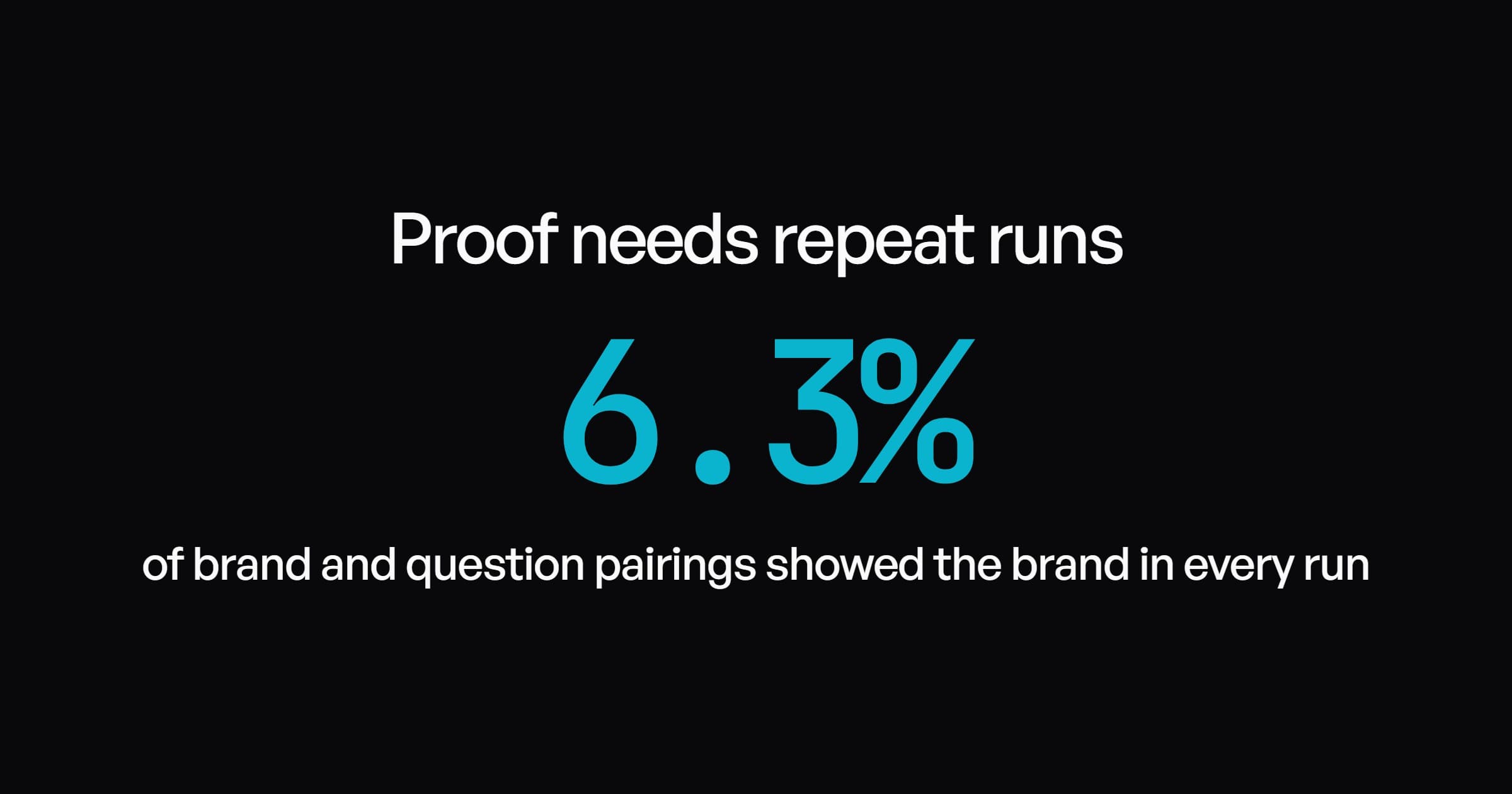
Across the 390 question and engine pairings that had an owner, the run holds 3,747 single answers. The owner was missing from 370 of them (9.9%). In 1,715 (45.8%), the owner was not the first brand mentioned.
So an audit that runs each question once will miss the owner about one time in ten. Almost half the time, the owner will not be the first brand that single answer mentions.
A sound audit runs every question several times on each engine. It uses the same run count in every audit and reports that count beside the results.
How should the question set be built?
A good question set has three layers: category, use case, and comparison. Twenty to thirty questions across these layers give a clear picture without eating a week.
| Layer | Example questions | What it shows |
|---|---|---|
| Category | "What is the best [category] tool?" | Which brand is the default answer |
| Use case | "Best [category] for agencies" | Where rivals own a niche |
| Comparison | "[Competitor A] vs [Competitor B]" | How engines frame the field, at the highest intent |
The sunscreen rows above show why use-case questions earn their place. On no engine did the plain category question and all of its use-case variants share one owner.
How is the audit run?
Each question runs on each engine several times. Every answer goes into the log: the question, the engine, the run, the brands mentioned in order, and the cited sources.
The summary tab carries four signals per brand per engine, kept separate: mention rate, average position, share of voice, and citation share. Beside them sits the ownership map, with the run count behind every cell.
| Signal | What it measures |
|---|---|
| Mention rate | How often the rival appears in answers to the question set |
| Average position | Where it lands in the answer: first, second, or later |
| Share of voice per engine | How its showing differs across engines |
| Citation share | Which outside sources the engine draws on when it mentions the rival |
How should the audit explain why a rival owns a question?
The explanation starts with the cited sources in the answers the rival owns. Review sites, publishers, retailers, and the rival's own pages each point to a different kind of investment, and the citations show which one the engine leaned on.
Any explanation stays a hypothesis until the citations support it. When a rival owns a question on one engine and not another, the sources each engine cites are the first thing to compare.
An audit repeated monthly turns the map into a trend. A rival that takes over a question it did not own last month is an early sign that its coverage changed.
Why doesn't the audit produce one AI visibility score?
A single score would blend four different questions into one number. A rival could lead on mention rate, trail on position, and win on citations, and the score would show only the net.
The signals stay separate so each gap points at its own fix. Why one visibility score hides the decision covers the reasoning.
The AI visibility baseline guide covers running the same audit on the brand's own visibility first. Closing the gaps usually starts with content, and how to write content that AI engines cite covers what to change on the page.
Where does the data come from?
The figures come from Zumi's own prompt run for an industry report on Indian beauty and personal care, run daily from 23 July to 2 August 2026. The 250 questions are unbranded buyer questions built from real Google search demand, with no brand in the question.
Each question ran 7 to 10 times per engine on ChatGPT, Google AI Overviews, and Perplexity, for 7,175 answers. Repeated runs of one question are repetitions, not independent buyers. Only product brands count as owners; retailers and marketplaces do not, and brands are shown as letters.
Zumi is an AI Search Intelligence Platform that runs this same audit on a schedule, per engine, instead of by hand once a month. Book a demo to see a real competitor set broken down by the four signals.