

Ask Google AI Overviews what to look for in an AI search intelligence platform, and about a third of the time it warns about the dark funnel. Ask Gemini the same question 26 times, and it raises the term twice.
Same company. Same question. Same three weeks. One engine treats the dark funnel as central to the category, and the other two barely mention it.
Key takeaways
- Google AI Overviews used "Dark Funnel" in 8 of its 25 tracked answers. Gemini used it in 2 of 26 and AI Mode in 1 of 26.
- The dark funnel describes buyer research that happens where attribution software cannot follow it. The term predates AI search by years.
- Vocabulary moved inside the study window: AI Overviews used "Answer Engine Optimization" in 5 of its first 9 tracked answers and 0 of its last 9.
- 253 of the 362 domains these engines cited appeared in exactly one answer, so the sources behind the framing rotate faster than a quarterly report can capture.
- A dark-funnel diagnosis drawn from one engine describes that engine, not the category.
What the dark funnel means
The dark funnel is the part of a buying process that happens where tracking cannot reach: peer conversations, private communities, review sites read without a click, podcasts, and forwarded links. The term was coined by 6sense and spread through the intent-data category, well before AI answers existed (Cognism, undated).
That definition is settled, and repeating it at length adds nothing. The interesting question is not what the dark funnel is. It is who says a brand has one.
One Google engine talks about the dark funnel. Its siblings do not.
For 19 days in July and August 2026, Zumi asked Gemini, Google AI Overviews, and Google AI Mode the same question with identical wording: what to look for in an AI search intelligence platform for marketing and demand generation teams. That produced 77 answers. Every answer was recorded and the vocabulary counted.
| Term | Gemini | AI Overviews | AI Mode |
|---|---|---|---|
| "Dark Funnel" | 2 of 26 | 8 of 25 | 1 of 26 |
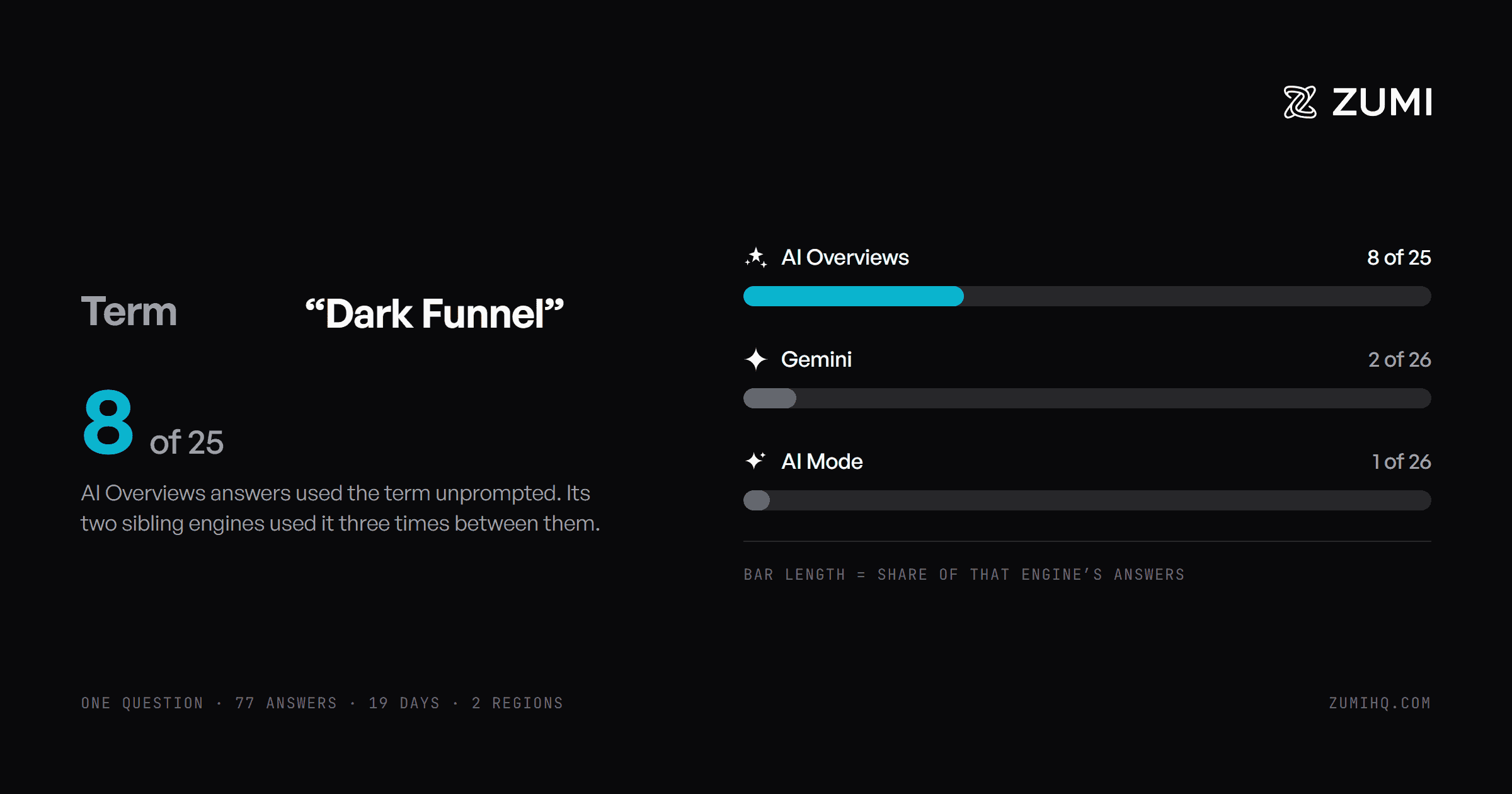
AI Overviews used the term in 8 of its 25 answers, more than Gemini's 2 of 26 and AI Mode's 1 of 26. Nobody prompted it. The question never used the phrase.
One question over 19 days produced those counts, so they describe this category and this window rather than a general property of the engines. A different question would likely move them.
This matters because of how category language forms. A buyer who researches this category through AI Overviews arrives at a sales conversation already framing the problem as attribution loss. A buyer who researches the same category through AI Mode almost never meets the term at all. Both buyers used Google.
The framing is not stable, even inside one engine
Vocabulary moved during the study window. AI Overviews used "Answer Engine Optimization" in 5 of its first 9 tracked answers and 0 of its last 9. AI Mode moved the other way on "Generative Engine Optimization", from 3 of 9 to 8 of 9.
Three weeks changed which acronym an engine reached for. A messaging decision anchored to an engine's vocabulary in July would have been describing a different vocabulary by August.
Gemini was the exception. It stayed inside one vocabulary throughout, using "sentiment" in all 26 answers and "share of voice" in 20 of them.
The sources behind the framing rotate
The instability runs deeper than word choice. Across all three engines, 253 of the 362 cited domains appeared in exactly one answer. That is 70% of the sources showing up once and never again, and the pattern held per engine.
| Engine | Domains cited once |
|---|---|
| Gemini | 71% |
| AI Overviews | 77% |
| AI Mode | 72% |
The dark funnel is usually described as a visibility problem, something a measurement tool resolves by making the invisible visible. This data complicates that. The thing being measured also moves. A single reading describes one day, not a position, which is why AI visibility is a tracked signal rather than a one-time audit.
The full study, including which nine domains all three engines agreed on and what those pages had in common, is here: Gemini, AI Overviews, and AI Mode cite differently.
What this changes for a measurement program
Three consequences follow.
Engine coverage is not interchangeable. A brand measuring only AI Overviews will see dark-funnel language and conclude the category runs on attribution anxiety. A brand measuring only AI Mode will not see it at all. Coverage decisions determine which conclusions are reachable, which is the argument for tracking engines separately rather than as an aggregate.
Frequency has to match the drift. A vocabulary that inverts inside three weeks cannot be captured by quarterly sampling.
Vocabulary is a finding, not a footnote. The words an engine reaches for unprompted describe how it has modelled the category, and that model is what reaches buyers.
When the dark funnel is not the right frame
The dark funnel describes untracked influence. It is the right frame when the question is why pipeline appears without a traceable source, and the honest answer is that the research happened somewhere analytics could not follow.
It is the wrong frame for two other situations that get filed under it. The first is a brand absent from AI answers entirely, which is a presence problem rather than an attribution problem, and no amount of attribution work fixes it. The second is a brand present but described inaccurately, where the answer is visible, traceable, and wrong.
Neither situation is dark. Both are measurable directly.
Reaching for the dark funnel in those cases turns a solvable problem into an unsolvable one.
What this study does not cover
One question, one category, three Google engines, 19 days. It says nothing about ChatGPT, Perplexity, Claude, Copilot, Grok, or DeepSeek, whose vocabulary was not measured here, and nothing about whether dark-funnel language correlates with anything a buyer does. A larger question set would likely shift the counts.
What it does establish is narrow and checkable: on this question, in this window, Google's three engines did not agree that this category is about the dark funnel, and one of them changed its mind about the vocabulary partway through.
The four signals behind these measurements are explained in AI Search Intelligence metrics that matter.
Zumi is an AI Search Intelligence Platform that tracks how AI engines describe brands and categories across up to nine engines. Book a demo to see what the engines say about a specific category.