
The AI search category has a data problem. Vendor decks quote adoption percentages nobody can trace, "studies" of thousands of queries nobody can inspect, and lift numbers with no methodology attached. For a discipline whose entire premise is that AI engines reward trustworthy sources, that's an awkward habit.
So this piece holds itself to a stricter standard: every number in it is third-party, attributed, dated, and linked. No first-party survey, no proprietary corpus, no composite. Just the published record as of October 2026, and what it adds up to.
It adds up to three findings. Adoption is settled. B2B got there first. And the metric marketing teams spent twenty years optimizing no longer describes how buyers behave.
Key takeaways
- AI search adoption is no longer a forecast: Google reports 2.5 billion monthly users on AI Overviews and over 1 billion on AI Mode, and independent analysis from Graphite puts all AI assistant usage at roughly 56% the size of search, and 28% when only search-like prompts are counted.
- B2B is ahead of the curve, not behind it. Forrester finds 90% of organizations already use generative AI in their purchasing process, and generative AI tools were the most cited meaningful interaction for researching purchases in its 2025 survey.
- Visibility has decoupled from traffic: users click any link in only 8% of visits with an AI summary present, and a randomized experiment puts the drop in outbound organic clicks at 39.8%.
- The public record covers adoption and click behavior well, but no broad public dataset covers per-category engine mix or citation patterns. The few measurements at that resolution are narrow, and each states its scope.
- The defensible response is to measure brand presence inside AI answers directly, in one's own category, where the results can be checked against the engines themselves.
How big has AI search adoption gotten in 2026?
AI search adoption is no longer a forecast. Google reported 2.5 billion monthly users on AI Overviews and over 1 billion on AI Mode by mid-2026, while independent analysis found total AI assistant usage equals roughly 56% of search engine volume worldwide, with ChatGPT accounting for 89% of AI sessions.
The scale numbers stopped being interesting as predictions and started being interesting as baselines.
At I/O 2026, Google reported that AI Overviews now has over 2.5 billion monthly active users, and that AI Mode passed 1 billion monthly users within a year of launch. The velocity matters more than the totals: in July 2025, AI Mode counted roughly 100 million monthly users across the US and India. A tenfold jump in under a year is not a feature finding its audience. It's a default behavior forming.
Outside Google, the picture is the same. A March 2026 analysis by Graphite.io, also reported by Search Engine Land, estimates AI tools now generate 45 billion monthly sessions worldwide, about 56% the size of search, with ChatGPT representing 89% of global AI sessions.
The 56% counts all AI usage. Counting only search-like prompts (the "asking" use case), Graphite puts AI at 28% the size of search worldwide and 17% in the US. Both numbers are real; they answer different questions. Most of that activity happens in mobile apps, which is one reason it stays invisible to teams watching web analytics.
None of these figures says anything about any individual brand. What they establish is that the channel is no longer optional to understand. The question left is who shows up in it.
Did B2B buyers adopt AI search faster than consumers?
Yes. Forrester found 90% of organizations already use generative AI somewhere in their purchasing process, and B2B buyers adopt AI-powered search at three times the rate of consumers. Its 2025 survey, published in January 2026, found generative AI tools were the single most cited meaningful interaction for researching purchases.
The lazy assumption was that AI search is a consumer phenomenon that would reach B2B eventually. The data says the opposite happened.
Forrester's Buyers' Journey research, drawing on its 2024 survey and reported by Digital Commerce 360 in July 2025, found that 90% of organizations now use generative AI in some aspect of their purchasing process, and that B2B buyers are adopting AI-powered search at three times the rate of consumers. The same report measured AI driving 2% to 6% of total B2B organic traffic, growing more than 40% per month. Those figures describe mid-2025 and are a floor, not a current reading.
The newer record points the same way, with a caution attached. In The State of Business Buying, 2026, published in January 2026, Forrester reports that generative AI searches are now the starting point for B2B buyers. Digital Commerce 360's coverage adds that 36% of respondents felt more confident in their decision because they used generative AI, while 20% felt less confident after meeting unreliable or inaccurate information. Buyers use the answer as a starting point, then check it with colleagues and trusted sources.
The mechanics explain why. A B2B evaluation is research-heavy by design: long lists, feature comparisons, pricing logic, integration questions. That's precisely the work conversational engines compress from hours to minutes.
A buying committee (Forrester counts 13 internal stakeholders and nine external influencers in a typical decision) doesn't browse ten vendor sites together. Increasingly, someone asks ChatGPT, Gemini, or Perplexity to draft the shortlist, and the committee debates what comes back.
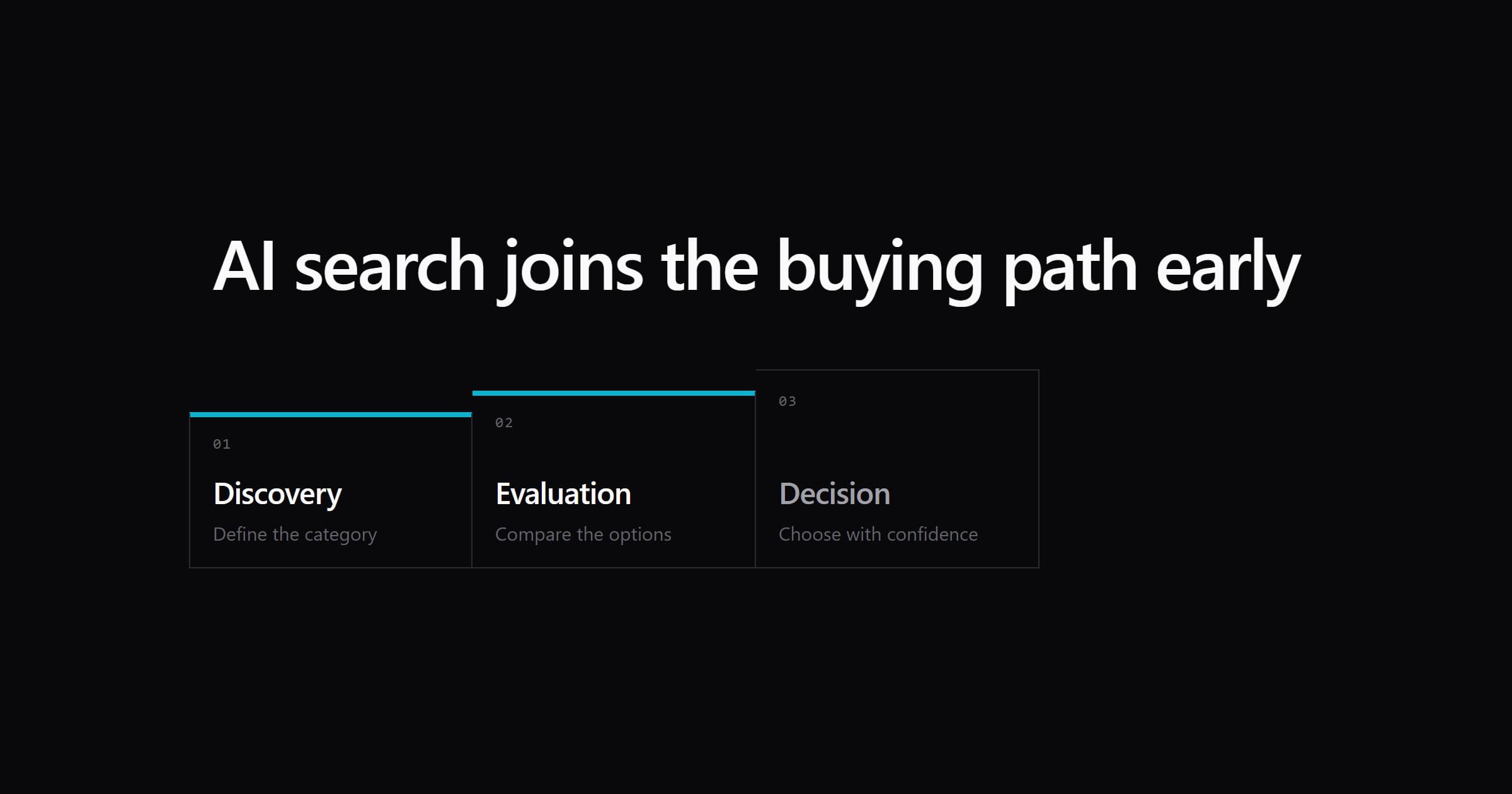
For a marketing leader, that relocates the most consequential moment of the funnel. The shortlist conversation now happens inside an answer, before the first site visit ever registers.
Why has visibility decoupled from traffic?
Users click a result link in only 8% of visits when an AI summary is present, versus 15% without one. The buyer's shortlist conversation now happens inside the answer itself, before a site visit ever registers.
The sharpest finding in the public record is what AI answers do to clicks.
Pew Research measured the effect from the user side: with an AI summary on the page, people click a result link in roughly 8% of visits, versus 15% without one. And Gartner's much-cited forecast, made back in early 2024, expects traditional search volume to fall 25% by the end of 2026 as buyers shift to AI chatbots and agents.
The Pew figure is observational: it compares visits with and without an AI summary. A randomized field experiment supplies a causal counterweight. In a study of 1,065 desktop Chrome users, Agarwal (Indian School of Business) and Sen (Carnegie Mellon University) randomly showed or hid AI Overviews with a browser extension and found outbound organic clicks fell 39.8% when an AI Overview appeared, zero-click searches rose 34.5%, and sponsored clicks stayed flat.
The paper was posted to SSRN in April 2026 and revised in June 2026. It points the same direction as Pew's observational data, and as a controlled test it isolates the AI Overview itself as the cause.
Read together, these numbers describe a structural change, not a dip. The answer itself became the destination. A brand can hold the #1 organic position, watch its traffic erode, and conclude the channel is dying, when what actually happened is the buyer got their answer one layer up, in a summary that may or may not have mentioned the brand at all.
That's why session counts and rankings have quietly stopped describing reality. The unit that matters in AI search is presence: whether the answer mentions the brand, what it says, and which sources it pulled from.
What can't the public record say about AI search yet?
The public record has solid evidence on adoption, click behavior, and aggregate engine share, but no broad public dataset shows which engines dominate specific buying categories or how citation patterns differ by vertical. The few measurements at that resolution are narrow, and claims that offer more precision deserve direct methodology questions: who ran the queries, and can the results be checked?
Honesty about the data requires naming its limits.
There is solid public evidence on adoption, on click behavior, and on aggregate engine share. There is no broad, auditable public dataset on the things practitioners most want to know: which engines dominate which buying categories, how citation patterns differ by vertical, or how often a given engine mentions a given class of brand. The published studies stop at the aggregate level.
That gap is exactly where unverifiable vendor research tends to bloom. When a report claims category-level precision (thousands of queries, hundreds of categories, neat percentage findings), the methodology questions are fair game: who ran the queries, when, on which engine versions, and can the answer corpus be inspected? If the answer is no, the number is marketing, not measurement.
The defensible alternative isn't to wait for a perfect public study. It's to measure the category directly: run the actual buyer questions against the actual engines, on a schedule, and keep the receipts. Zumi, an AI Search Intelligence Platform that monitors brands across up to nine engines daily, has published two such measurements, with their narrow scope stated up front:
- Gemini, AI Overviews, and AI Mode cite differently asked one question about buying an AI search intelligence platform, daily for 19 days, and collected 77 answers. The three engines cited 362 domains and shared 9. That describes one question in one category over one window, not a general property of any engine.
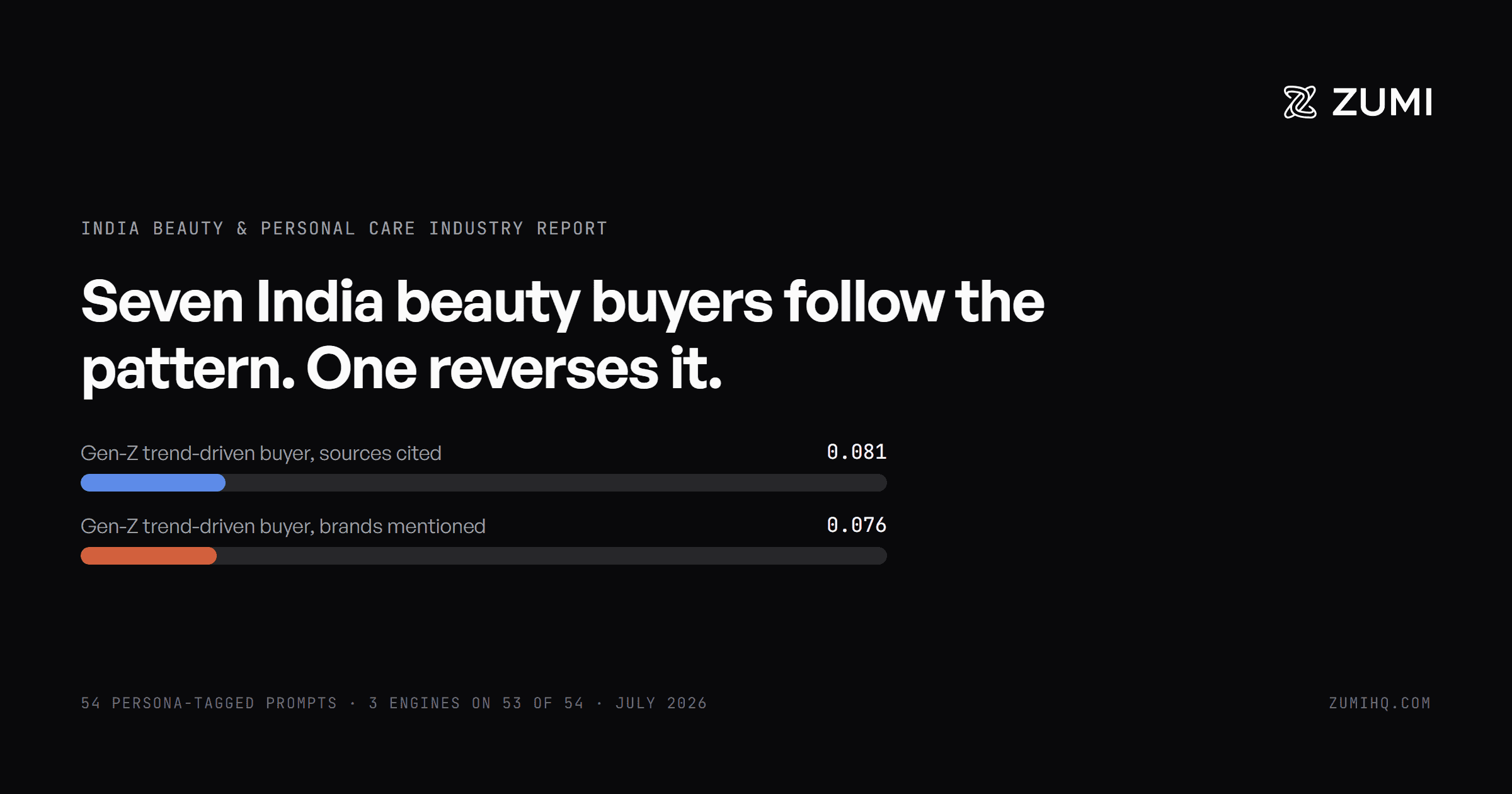
- For one India beauty buyer, AI engines agree on the source before the brand covers 54 persona-tagged India beauty queries from an 11-day run in July 2026. Seven of eight buyer segments show engines agreeing more on brands than on sources, with support per segment as low as four prompts.
Neither study generalizes beyond its category, and neither replaces a public dataset. They show what a measurement at category resolution looks like, and that the same prompts can be re-run against the engines and compared.
What should a marketing team do with this record?
Baseline brand presence across the real engines buyers use rather than traffic alone, weight engine coverage to the actual buying category instead of global averages, and treat falling clicks as a measurement problem before declaring a channel dead. Hold every internal stat to the same standard used here: a cited, dated, working source.
A practical reading of the October 2026 record, for a team that owns a brand's pipeline:
- Baseline presence, not traffic. Run the category's real buying questions through ChatGPT, Gemini, Perplexity, Claude, Copilot, and AI Overviews, and record whether and how the brand appears. That baseline is the number the rest of the work moves.
- Weight the engines by the buyer, not by headlines. ChatGPT's 89% share of global AI sessions is an average across everything, and the 56% and 28% figures above show how much the definition of "search" moves a headline. A specific B2B category can look very different, and the mix shifts.
- Treat falling clicks as a measurement problem first. Before declaring a channel dead, check what the AI layer above it is saying. The traffic didn't vanish, the decision moved.
- Hold every stat to the standard in this piece. Cited source, date, working link. Content built on attributable data is also, not coincidentally, the kind AI engines cite.
One more piece adds detail on the buying side: how B2B buyers use AI when researching vendors.
The shift is measured, public, and faster in B2B than anywhere else. The open question is brand-specific. Zumi pulls the live answers for a real category in a demo, with no deck required. Book a demo.
Sources
| Source | Finding | Date |
|---|---|---|
| Google, Sundar Pichai I/O 2026 keynote | AI Overviews passed 2.5 billion monthly active users; AI Mode passed 1 billion monthly users in its first year | I/O 2026 |
| TechCrunch | AI Overviews had 2 billion monthly users; AI Mode had 100 million monthly users in the US and India | July 2025 |
| Graphite.io, "AI Is Much Bigger Than You Think" | AI usage is 56% the size of search worldwide; search-like "asking" prompts are 28%; ChatGPT holds 89% of AI sessions | March 2026 |
| Search Engine Land, reporting the Graphite.io analysis | Secondary coverage of the Graphite figures | March 2026 |
| Digital Commerce 360, reporting Forrester's Buyers' Journey Survey | AI search is reshaping B2B marketing | July 2025 |
| Forrester, "The State of Business Buying, 2026" press release | Generative AI searches are the starting point for B2B buyers; buying group of 13 internal stakeholders and nine external influencers | January 2026 |
| Digital Commerce 360, reporting the same Forrester report | Generative AI tools were the most cited meaningful research interaction; 36% more confident, 20% less confident | January 2026 |
| PPC Land, reporting Agarwal and Sen (SSRN) | Randomized field experiment, 1,065 desktop Chrome users: outbound organic clicks down 39.8%, zero-click searches up 34.5% when an AI Overview appears | April 2026, revised June 2026 |
| Pew Research Center | Google users are less likely to click on links when an AI summary appears in the results | July 2025 |
| Gartner | Search engine volume will drop 25% by 2026 due to AI chatbots and other virtual agents | February 2024 |