
SEO was learned in an era where the whole job was ranking on a list. A page gets optimized, it climbs the rankings, people click. That model held for two decades.
It is breaking now. When a buyer asks ChatGPT "what's the best CRM for a mid-market SaaS company?", there are no ten blue links, only a direct answer that mentions one or two brands. Every other brand is missing from that answer.
What is Generative Engine Optimization (GEO)?
Generative Engine Optimization, or GEO, is the discipline of making a brand one of the few that gets mentioned when an AI engine answers a buyer's question, across whichever engines that brand's own buyers actually ask. It sits next to SEO rather than replacing it: SEO earns a ranked position in a list of links, GEO earns inclusion inside a generated answer that has no ranked positions at all.
Key takeaways
- Generative Engine Optimization (GEO) is the practice of getting a brand mentioned inside AI-generated answers, the way SEO earned a ranking in a list of links.
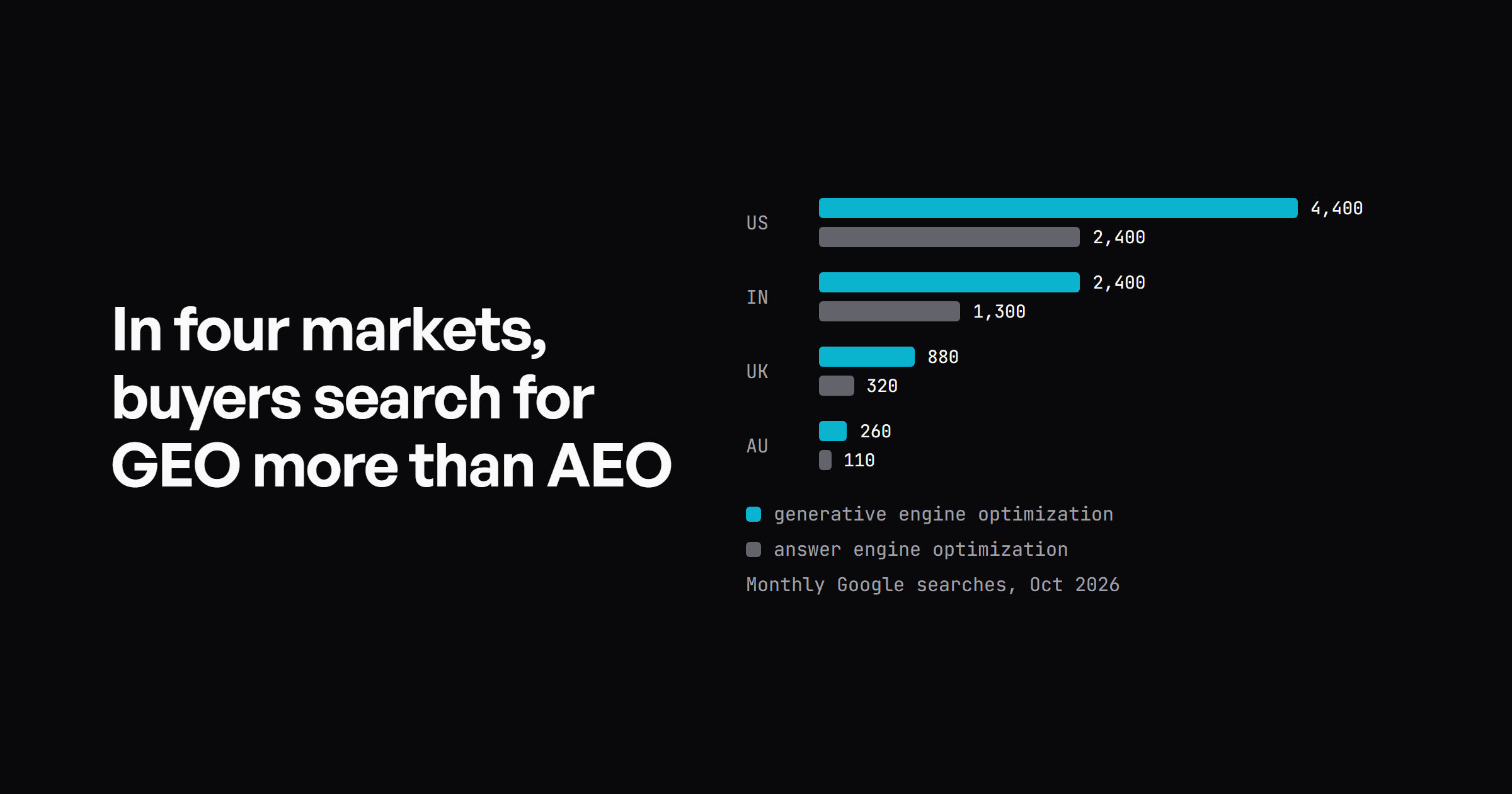
- GEO is also called answer engine optimization (AEO). The two names describe the same work, and GEO is the larger term: worldwide, Google searches for "generative engine optimization" run 2.7 times higher than for "answer engine optimization".
- GEO signals differ from SEO signals: citation authority, entity clarity, content depth, and mention frequency matter more than backlinks and keyword density.
- Buyers spread across up to nine major AI engines (ChatGPT, Gemini, Perplexity, Claude, Copilot, Grok, Google AI Overviews, Google AI Mode, DeepSeek); a strategy should track the ones a brand's own buyers actually use, and scale from there.
- GEO compounds. Brands that establish AI visibility early become the default recommendations that competitors struggle to displace.
How does GEO differ from SEO?
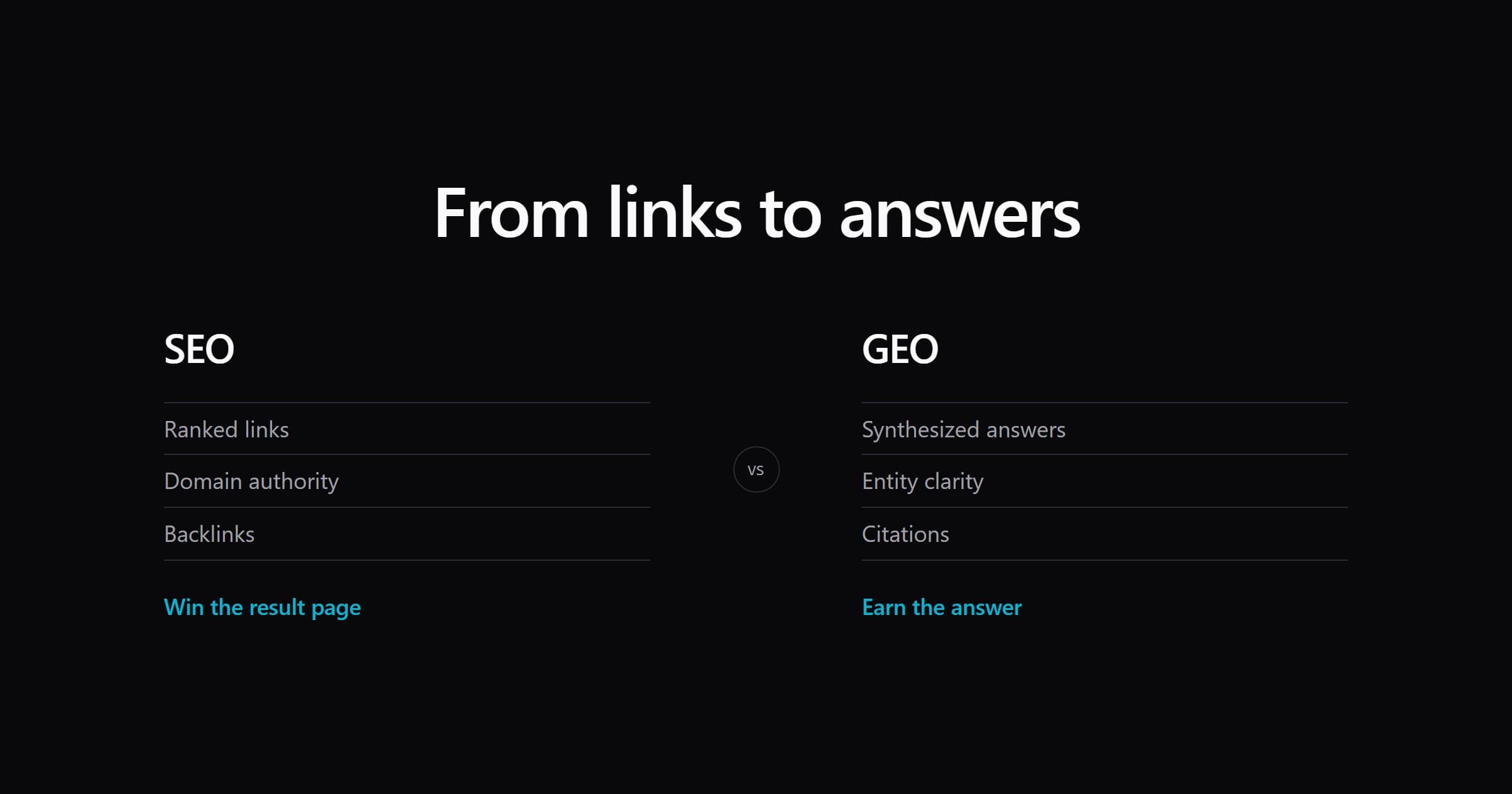
GEO and SEO optimize for different outcomes and respond to different signals. SEO earns a ranked position through backlinks, keyword density, page speed, and structured data. GEO earns inclusion in an answer through citation authority, entity clarity, content depth, and mention frequency, and a brand can rank well in Google while staying invisible in an AI answer to the same question.
| SEO | GEO | |
|---|---|---|
| Optimizes for | A ranked position on a results page | Inclusion inside a generated answer |
| Core signals | Backlinks, keyword density, page speed, structured data | Citation authority, entity clarity, content depth, mention frequency |
| Output the buyer sees | A list of links to choose from | A direct answer that mentions one or two brands |
SEO still matters and still shapes some of these signals from underneath, since content quality and topical authority carry over to both, but SEO alone is no longer enough. For the fuller breakdown of what carries over, what diverges, and how to split budget between the two, see GEO vs. SEO.
Is GEO the same as AEO?
In practice, yes. Answer engine optimization (AEO) is another name for getting a brand mentioned, and its pages cited, inside AI-generated answers. The AEO label comes from the era of featured snippets and voice assistants, and GEO comes from a 2023 research paper by Aggarwal and colleagues.
GEO is the term more buyers search for. Google Keyword Planner shows about 18,100 worldwide monthly searches for "generative engine optimization" against 6,600 for "answer engine optimization", pulled in October 2026 for English-language searches.
AEO is rising faster: over three months its searches rose 23% worldwide while GEO's fell 18%. The AEO vs GEO comparison breaks the demand down by market and shows which term each AI engine uses.
Which AI engines does GEO cover?
GEO covers up to nine major AI engines: ChatGPT, Gemini, Perplexity, Claude, Microsoft Copilot, Grok, Google AI Overviews, Google AI Mode, and DeepSeek. Buyers spread across these unevenly by category, so a GEO strategy does not need every engine tracked from day one. It needs the engines a given brand's own buyers actually use, scoped to what the program needs, with room to expand as it grows.
Each engine behaves differently:
- ChatGPT is conversational and opinionated, and is used heavily for purchase decisions.
- Gemini is integrated with Google Search and Workspace, making it a major purchase-intent surface.
- Perplexity is citation-first: every claim it makes is sourced, so understanding what gets cited there is direct intelligence.
- Claude is favored by business buyers and knowledge workers.
- Microsoft Copilot sits inside Windows, Teams, and Outlook, reaching buyers inside their daily workflow.
- Grok is native to X and matters most in developer, finance, and creator-economy categories where social signals shape buying.
- Google AI Overviews sits above traditional Google results and is reshaping which domains win category-defining queries.
- Google AI Mode is Google's separate conversational search surface, growing fast on its own.
- DeepSeek is gaining share in developer, research, and global markets.
What does a GEO strategy look like in practice?
A GEO strategy runs three repeating cycles: monitor, analyze, and optimize. Each is described below. The groundwork under all three, a clear and consistent brand identity, is covered in entity optimization for AI.
Monitor: continuously query AI engines with the most important market queries. What does ChatGPT say when someone asks about the category, and is the brand mentioned or a competitor instead?
Analyze: go beyond "is the brand mentioned?" to "why?". What content is being cited? What competitor is getting recommended, and what do they have that the brand doesn't?
Optimize: act on the analysis. Fill the content gaps AI engines are missing, and build authority in the citation sources that matter.
For a full operating model built on these three cycles, see the CMO guide to AI Search Intelligence, which lays out a 90-day plan for running the program.
Why does GEO matter now?
GEO matters now because the advantage compounds for whoever moves first.
AI engines learn from the web and from each other's answers. Brands that show up in trusted sources today become tomorrow's default picks. Brands that wait will have to unseat rivals already settled in those answers.
The real question is not whether to invest in GEO. It is whether to do it before competitors get there first.
Zumi is an AI Search Intelligence Platform built for exactly this. It queries ChatGPT, Gemini, Perplexity, Claude, and up to five more engines daily, measures how often a brand is mentioned and how prominently, and shows which sources to fix to move it. Book a demo to see it against a real category.