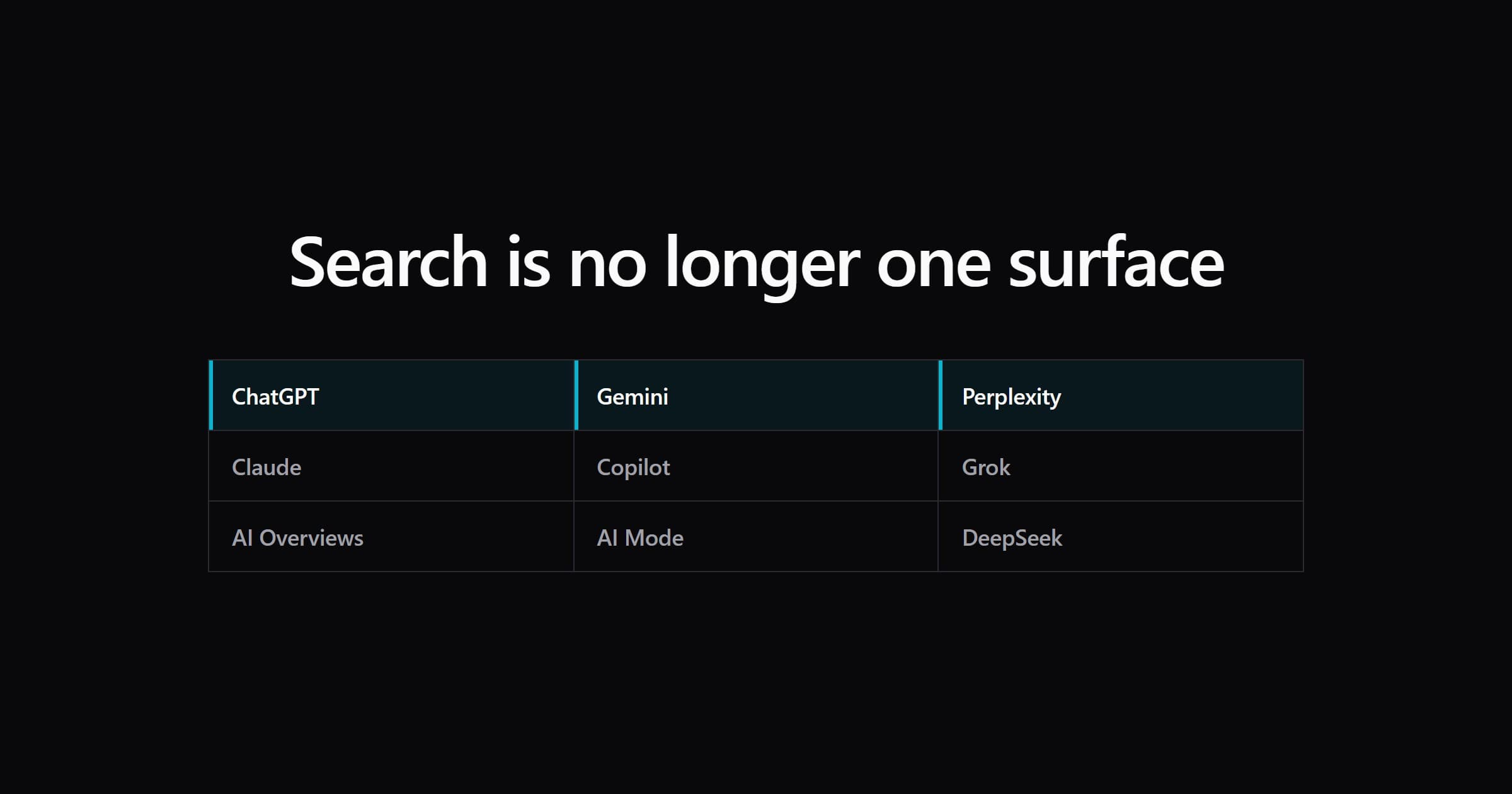

On July 23, 2025, Google said AI Overviews had passed 2 billion monthly users. AI Mode had also passed 100 million monthly active users in the United States and India. Both figures came from Alphabet's second-quarter update reported by TechCrunch.
Those adoption figures made AI-mediated discovery a distribution question at executive scale. They did not create a clean revenue-attribution model for any individual brand.
That distinction should shape the CMO program. AI Search Intelligence can measure how a brand appears, which sources support the answer, where competitors lead, and which owned- or earned-media work deserves attention. It cannot claim that an observed visibility change caused pipeline or revenue.
Key takeaways
- Google reported more than 2 billion monthly AI Overview users in July 2025. It also reported more than 100 million monthly AI Mode users, but neither figure proves commercial impact for one brand.
- The operating cycle keeps six inputs fixed: buyer questions, prompt version, engine scope, geography, sampling, and counting rules.
- The executive view reports four separate signals: mention rate, share of voice, average position, and citation share.
- Weeks 5 through 10 belong to the teams that write, publish, maintain the website, and earn coverage. Measurement does not replace execution.
- The board memo ends with limitations and the next measurement date, not an invented AI-attributed pipeline figure.
What does AI Search Intelligence do that a single metric can't?
AI Search Intelligence turns a metric into an operating decision. It sets which buyer questions to watch and keeps the answers and sources behind them. It keeps four visibility signals separate rather than folding them into one score. Then it gives the work to a named owner and measures the same scope again on a fixed cycle.
AI Visibility describes how prominently a brand appears across tracked AI engines. Zumi is an AI Search Intelligence Platform. Its metric dictionary defines mention rate, share of voice, average position, and citation share as four separate descriptive signals.
AI Search Intelligence is the wider operating discipline. It defines the questions worth observing, preserves the answers and sources, separates the four signals, assigns the resulting work, and measures the same scope again.
The distinction matters because a dashboard can report movement without creating accountability. A CMO needs to know which decision follows, which team owns it, and which claim the evidence can support. That is the role of the 90-day cycle.
What happens in the first four weeks of the cycle?
The first four weeks fix the measurement object before any results are reviewed. Weeks one and two define the buyer-question panel, named engines, competitors, and counting rules. Weeks three and four run the unedited baseline across those questions, capturing mention rate, share of voice, average position, and citation share separately.
Weeks 1 and 2 fix the measurement object
The first two weeks prevent a changed ruler from becoming a success story. The program owner defines the buyer-question universe before any baseline is reviewed.
The scope record contains:
- Market, geography, language, and target audience
- Unbranded category, use-case, comparison, and problem questions
- Stable prompt IDs and a versioned prompt panel
- Named engines or answer products selected for the audience
- Declared competitors and canonical entity names
- Session, sampling, exclusion, and counting rules
- Decision owner and executive review date
Engine scope follows the audience and engagement. Zumi can cover up to nine AI engines, with the tracked set scoped to the requirement. A report should state the exact set measured rather than convert platform capacity into a claim of universal coverage.
The prompt panel also stays unbranded where the purpose is discovery. A question containing the brand name tests description or validation. It does not test whether the brand enters an unprompted category answer.
Weeks 3 and 4 establish a four-signal baseline
The baseline captures the unedited answers and citations before the team begins work. Screenshots can make the result legible, but the structured answer record remains the evidence.
Each engine and question pair produces the same fields:
| Field | What it captures |
|---|---|
| Mention rate | Whether the brand appears across the eligible tracked answers |
| Share of voice | How the brand's presence compares with the named rivals |
| Average position | Where the brand lands when it appears with other brands |
| Citation share | How often the brand's own pages support the answer |
| Engine disagreement | Where the same question produces different brand or source patterns |
| Source risk | Which pages, owned or not, carry old, weak, or conflicting facts |
The four signals remain separate. A composite score can make a board slide look tidy while hiding the reason for movement. The baseline should preserve the diagnosis that the next phase needs.
The baseline is also dated. One collection period describes what the selected engines returned under the stated conditions. It does not establish a permanent rank or an estimate of what every user saw.
What happens in weeks 5 through 12?
Weeks five through 10 turn the gaps in the baseline into a fixed list of work. Owned-media fixes go to the content and product marketing teams; earned-media targets go to public relations or an agency. Weeks 11 and 12 reuse the same unchanged panel, scope, competitors, and counting rules to measure the same object again.
Weeks 5 through 10 assign owned and earned work
The middle of the cycle turns observed gaps into a finite work queue. Zumi's Recommendations feature groups actions into Owned Media and Earned Media, then prioritizes them per engine. The brand or agency team performs the execution.
Owned-media work can include a missing category explanation, an outdated product page, inconsistent entity information, or a page that fails to answer the question an engine is resolving. Content, product marketing, and web teams own those changes.
Earned-media work begins with the third-party sources already cited for the category. Public relations, communications, partnerships, or an agency decides whether the missing coverage is relevant and attainable. Zumi identifies where coverage may matter; it does not conduct outreach on a public self-serve engagement.
The action register keeps observation and interpretation apart:
- Observation: The brand was absent from one priority question cluster in the selected engines.
- Source evidence: The answers cited category pages that did not mention the brand.
- Interpretation: The category may lack third-party support for the brand's stated fit.
- Action: The communications team evaluates the cited publications and corrects the owned category page.
- Owner: The register names the function and accountable leader.
- Review: The register stores the publication date, evidence link, and remeasurement date.
The register does not label every absence a content problem. Some gaps reflect weak relevance, a narrow product fit, inaccessible source material, or a prompt that never belonged in the panel. Removing a weak question requires a new panel version rather than a silent edit to the baseline.
Weeks 11 and 12 measure the same object again
The final phase reuses the unchanged panel, scope, competitors, and counting rules. New questions can enter a separate series, but they should not pad the original comparison.
The review asks four questions:
- Which of the four signals changed within the original scope?
- Which questions, engines, and sources account for the movement?
- Which owned- or earned-media actions were completed before the second measurement?
- Which explanations remain plausible but unproven?
A before-and-after comparison is observed evidence, not a controlled experiment. Engines, retrieval systems, source indexes, and rival content can all change in the same period.
The report can state that a movement followed a shipped action and shows up in the affected question cluster. It should not call the action the sole cause.
Who owns the AI Search Intelligence program?
No single team owns AI discovery, because it crosses several operating functions. The CMO owns the business question, the budget boundary, and the decision standard. Product marketing, content, PR, web, analytics, legal, and agency partners each own the piece of the diagnosis their function has the authority to fix.
| Function | Owns |
|---|---|
| CMO or marketing leader | Scope, budget, the decision standard, and the story for the board |
| Product marketing | How the brand is defined, category words, product facts, and fair comparisons |
| Content | Owned-page gaps and evidence quality |
| Public relations or communications | Gaps in outside sources, and earned coverage |
| Web or technical search | Crawl access, page structure, and publishing |
| Analytics | Referral and sales data, kept in a separate layer |
| Legal or compliance | Claims, regulated wording, and risk review |
| Agency lead | One method across clients, consistent reports, and delivery where contracted |
No single team can repair every source behind an AI-generated answer. The operating model works because the diagnosis routes to the team with authority to act.
What does the board receive at the end of each cycle?
The board receives one page and one decision. That page says whether to continue, change, expand, narrow, or stop the program. It shows the four signals against the baseline, each on its own, and lists source risks and completed actions. It also states what the data cannot prove and names the next cycle's owner and measurement date.
The board memo should fit on one page. Supporting answer excerpts, source tables, and methodology notes can sit behind it.
The page contains:
- Decision required: Continue, change, expand, narrow, or stop the program.
- Scope measured: Buyer-question panel, market, engines, dates, and sampling.
- Four-signal movement: Each signal shown separately against the baseline.
- Engine disagreements: The material differences hidden by an average.
- Source risks: The pages shaping weak, outdated, or conflicting answers.
- Actions completed: Owned- and earned-media work that shipped during the cycle.
- Limitations: What the observation cannot establish.
- Next cycle: Accountable owner, budget, and measurement date.
The memo should include a typical answer excerpt, not the most flattering screenshot available. The excerpt makes the data concrete without replacing the panel.
What is the investment case for AI Search Intelligence?
The defensible budget case is operational, not causal. Marketing already manages how a brand appears in search results, media coverage, review sites, and owned content. AI-generated answers create another discovery layer that can be observed and governed the same way, funding a bounded baseline, source diagnosis, responsible action, and repeated measurement.
The decision after the first cycle can be to expand the scope, continue at the same level, reduce it, or stop.
A vendor evaluation should reject:
- A composite score without its formula and underlying signals
- A result with no prompt panel, engine scope, date, or raw answer evidence
- Engine-capacity language presented as identical coverage on every engagement
- Screenshots selected without a stable comparison set
- Causal revenue claims inferred from visibility movement
- Recommendations with no owner, evidence path, or remeasurement date
Commercial attribution remains outside this guide. Referral analysis, self-reported discovery, customer-relationship data, and incrementality work belong to a separate analytics design with their own evidence rules. The manual AI visibility baseline is the concrete starting point for a team that has not yet established the discovery measure.
For a team new to the discipline, what is Generative Engine Optimization is the starting point.