
AI engines draw on a small set of sources. In one study of 65,000 AI answers, the top 20 news outlets took 67.3% of all news citations in OpenAI's models. Published research now says a fair amount about which brand mentions follow from that, and which do not.
This post collects that evidence: academic studies, independent research, and the engines' own documentation.
Key takeaways
- AI engines lean on a small group of sources. In OpenAI's models, the top 20 news outlets took 67.3% of all news citations. The study counted outlets, not brands, but it shows how few sources an answer draws on.
- Adding statistics, direct quotations, and cited sources measurably lifted a page's visibility in AI answers, by up to 115% for lower-ranked pages. Keyword stuffing produced little to no improvement.
- ChatGPT often decides which brands are in the running before it searches. In one small study, brands it wrote into its own search query were mentioned 68.9% of the time, against 2.1% for brands whose pages it only fetched.
- Google's AI Overviews and AI Mode draw only on pages eligible for classic Search, so SEO work carries over there more directly than anywhere else.
- A mention in a source the engines already cite reaches more answers than another page on the brand's own site.
Which sources do AI engines draw on?
An arXiv study by Kai-Cheng Yang ("News Source Citing Patterns in AI Search Systems", July 2025) looked at 65,000 responses across OpenAI, Perplexity, and Google. In OpenAI's models, the top 20 news sources accounted for 67.3% of all news citations.
The study counted citations of news outlets, not brand mentions. It measures how concentrated the sources are, not which brands get mentioned. Google and Perplexity were less concentrated, but still leaned heavily toward the same few established outlets.
For brands, the lesson is indirect. The study says nothing about which brands engines prefer. It does show that engines read a small group of outlets far more than the rest, so a brand mentioned in those outlets is in front of the engine more often than a brand mentioned elsewhere.
What actually drives mentions?
1. Statistics, quotes, and cited sources
The most-cited piece of research in this field is the paper "GEO: Generative Engine Optimization" from researchers at Princeton and IIT Delhi (Aggarwal et al., KDD 2024). GEO, short for generative engine optimization, is the work of getting content into AI-written answers. The study tested specific page changes against 10,000 queries and measured how visible each page became in the generated answers.
Three changes produced a clear lift, and one did not:
- Adding statistics to existing content: roughly 30 to 40% more visibility
- Adding direct quotations from authoritative sources: a similar range
- Citing external sources within the content: up to 115% more visibility for pages that started lower in traditional rankings
- Keyword stuffing: little to no improvement over the unchanged page
Keyword stuffing, a common SEO habit, did almost nothing in the study. The changes that worked all make a page read as a credible explanation that can be checked.
2. A consistent description of the brand
AI engines treat a brand as one thing with known facts attached: what it sells, where it operates, and who it serves. When those facts differ from one source to the next, the engine has less to go on in deciding whether a page is about the brand in the question.
A brand whose Wikipedia article, Crunchbase profile, LinkedIn page, and own site describe it differently gives the engine conflicting versions to reconcile. A brand that describes itself the same way everywhere gives it one.
3. Source quality
Yang's study also found that the major engines lean heavily toward high-quality sources. OpenAI's models cited high-quality outlets 96.2% of the time. Google's cited high-quality outlets 92.2% of the time.
That leaves little room for pages on sites the engines do not treat as credible, however good the page itself is.
4. Google's AI features and classic Search
Google's own documentation settles the question for AI Overviews and AI Mode. To be shown as a supporting link, "a page must be indexed and eligible to be shown in Google Search with a snippet". Google adds that "best practices for SEO remain relevant" and that there are "no additional requirements to appear in AI Overviews or AI Mode".
Both features may also use "query fan-out", running several related searches on parts of a question to build one answer. A page can therefore earn a citation for a narrower question it ranks for, even when it does not rank for the question the user typed.
This is the most practical finding for SEO teams: existing SEO work carries over directly into Google's AI features. It does not carry over evenly to ChatGPT or Perplexity, which choose sources their own way.
5. Familiarity: the shortlist forms before the search
When several brands fit a question, engines lean toward the ones they already know. Search Engine Journal published a study by Suganthan Mohanadasan (August 2026) that shows where this happens in ChatGPT. In 21 of 27 conversations, the first search ChatGPT wrote for itself contained brands the user never typed.
Brands in that self-written search were mentioned in the answer 68.9% of the time. Brands whose pages were fetched but never appeared in a search were mentioned 2.1% of the time. The study covers 57 conversations from one researcher and has not been repeated, so it is a strong signal rather than a settled rule.
The finding suggests ChatGPT's live search partly reflects what it already knows. A newer brand can still gain on the live web, since Perplexity reads current pages and Google's features draw on current rankings.
In ChatGPT, a newer brand gains by becoming one the model already links to the category. That happens through the sources in the next section.
6. Mentions in sources the engines already cite
The evidence above points to one route that works across engines: being mentioned in the sources engines already use. Publications, analyst firms, and review sites that an engine treats as credible get cited often. A brand they mention appears in material the engine is already reading.
A claim that exists only on the brand's own site has no outside support. Pew Research Center's analysis of Google searches from March 2025 found that "the most frequently cited sources in both Google AI summaries and standard search results are Wikipedia, YouTube and Reddit" (Pew Research Center, 2025). None of the three is a brand's own site.
So a mention in a trade publication that already appears in Perplexity or ChatGPT answers for the category reaches more answers than another post on the brand's own site. Digital PR pays off when it targets the outlets the engines cite, rather than outlets chosen by audience size alone.
How do the engines differ?
The engines are not interchangeable. The public evidence points to different routes into each:
ChatGPT leans on what it already knows. The Search Engine Journal study suggests its shortlist often forms before it searches. That puts weight on how often a brand appears across the wider web, and how often it appears next to the category's terms.
Google AI Overviews and AI Mode draw only on pages eligible for classic Search, by Google's own documentation. Of all the AI features, these are where good SEO carries over most directly.
Perplexity reads live pages for every answer and shows each source as a numbered citation. That makes it the engine where a newly published, well-sourced page can appear fastest.
Claude has a user base that leans toward business, which matters more for B2B brands than Claude's overall consumer share would suggest.
What does this mean for a brand's plan?
The common thread across engines is the same: specific, well-sourced content from a brand that engines can identify without confusion. Without that base, engine-specific work does not add up.
Depth is part of that base. For each question a brand wants to own, the test is whether its page is the most complete and specific answer available. If it is not, a competitor's page is the likelier citation.
On top of that base, the engine-specific work:
- For ChatGPT: invest in the outside sources that shape what it already knows, such as Wikipedia, Crunchbase, and bylined articles in industry publications.
- For Google AI Overviews and AI Mode: treat this work as a layer on top of strong SEO. Indexing and snippet eligibility come first.
- For Perplexity: make pages easy to quote, with tables, comparisons, clearly named products and companies, and direct quotes. The Princeton and IIT Delhi results point directly at this. The page-level method is in how to write content that AI engines cite.
- For Claude: no public study yet shows how Claude chooses sources. Its business-heavy user base makes it worth tracking for B2B brands, and the page-level evidence above (statistics, quotes, and cited sources) is the safest place to start.
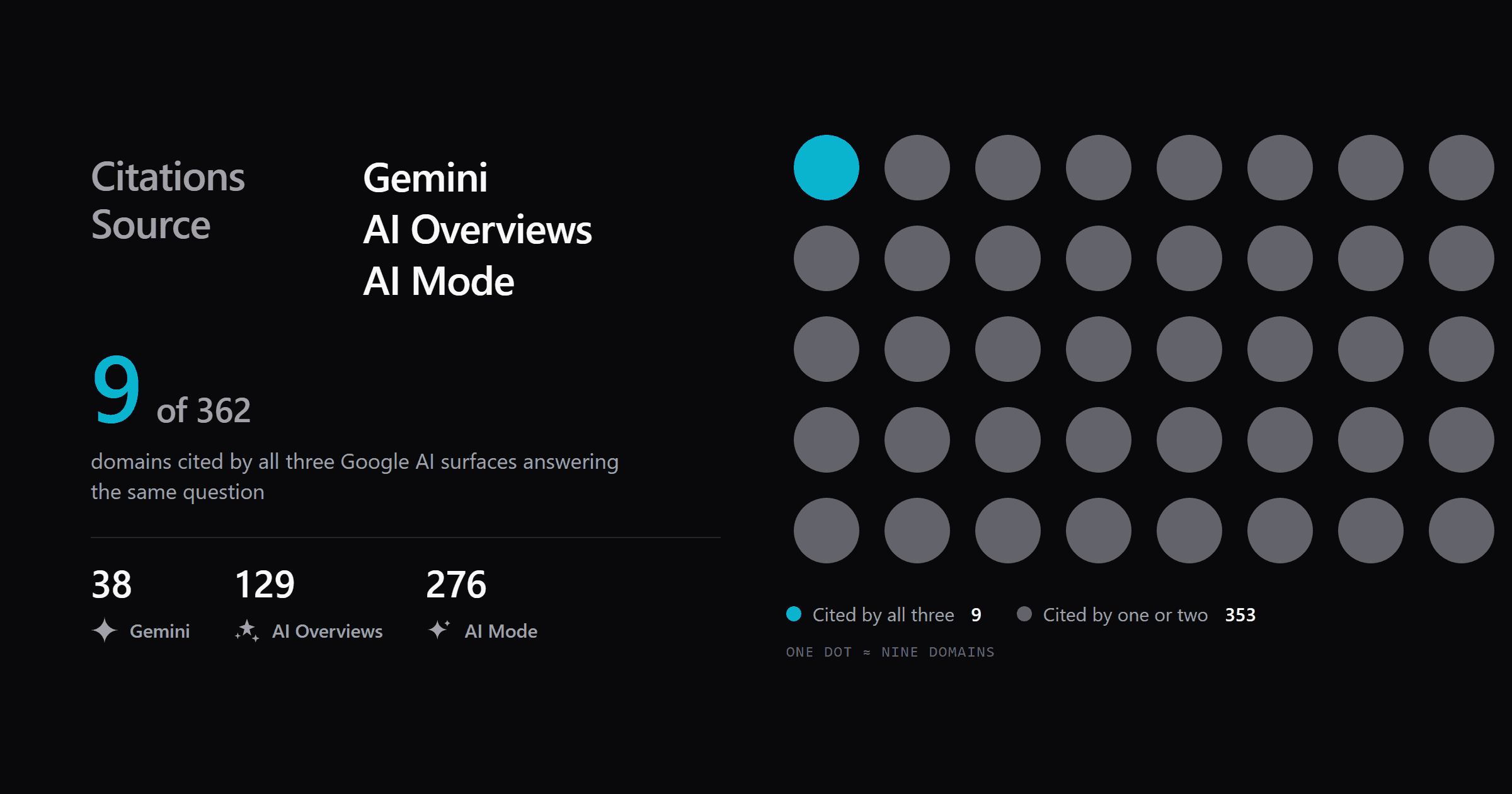
The differences run even inside one company: Gemini, AI Overviews, and AI Mode cite differently, even for the same question.
What does the research not settle?
Most of this evidence comes from a few studies, each with limits.
The Yang study counted news outlets, not brands. The Princeton and IIT Delhi study tested page changes in a research setting, not on live engines as they work today. The ChatGPT study covers 57 conversations from one researcher. No public study yet explains how Claude picks its sources.
AI engines also change. Findings from one quarter will not all hold the next, which is why ongoing tracking beats a one-off audit.
Zumi is an AI Search Intelligence Platform that tracks how up to nine AI engines, from ChatGPT to Perplexity, mention and cite brands. It reports mention rate, share of voice, average position, and citation share for each engine. Book a demo to see the breakdown for a specific brand and category.
Sources
- Aggarwal, P. et al. "GEO: Generative Engine Optimization." KDD 2024 / arXiv:2311.09735
- Yang, K-C. "News Source Citing Patterns in AI Search Systems." July 2025. arXiv:2507.05301
- Google Search Central. "AI features and your website." developers.google.com
- Mohanadasan, S. "ChatGPT Already Knows Who It'll Recommend Before It Searches." Search Engine Journal, August 14, 2026. searchenginejournal.com
- Pew Research Center. "Google users are less likely to click on links when an AI summary appears in the results" (July 22, 2025). pewresearch.org